
Why AI pilots aren’t boosting your P&L and what CBTS is doing differently
I was six in 1992. That’s around the time the desktop computer started landing.
At the time, I was busy playing Super Nintendo, so I didn’t sit through any of the sales pitches. And I’ve only read about what came after: economists struggling to quantify the resulting boost to productivity. Back then, the business community discovered that putting a computer on someone’s desk doesn’t produce instant results.
Today, we’re experiencing similar dynamics with AI. Capturing the value requires redesigning the work. And while it took a long time for organizations to make the most of desktop computing, I’m optimistic that we’ll get there much faster with AI.
After all, we don’t need to reinvent the playbook. We just need to dust it off.
No, you aren’t doing it wrong
Clients often tell me how one of their teams is using AI to move faster. Documents get summarized in minutes. Drafts that used to consume a morning now take 20 minutes. People like what they can do with the tools. But then a leader lowers their voice a little and says, “But I can’t find those gains in my numbers.”
That doesn’t mean they’re doing something wrong. AI shouldn’t show up in the numbers yet. I would be shocked if it did.
What they can point to is additional capacity. They can absorb more work with the same headcount, and the team is less underwater than it used to be. That’s real; it just isn’t something to put in front of a CFO.
CFO-worthy returns don’t arrive until a team stops optimizing individual tasks and starts reorganizing how an entire department does its work.
Five rungs, one ladder
There are five places where you can capture AI value, and they aren’t interchangeable.
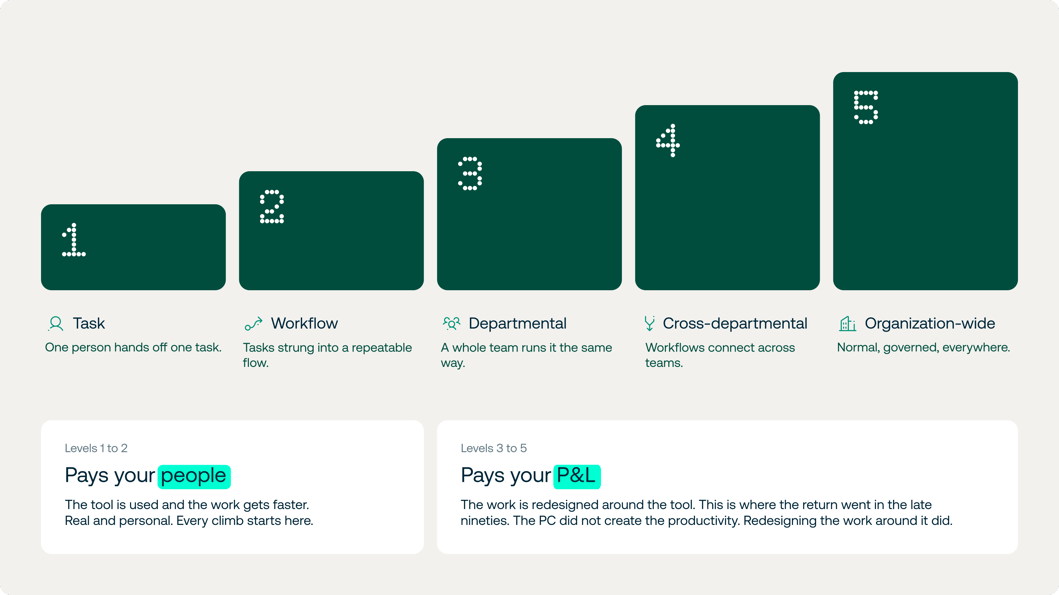
The bottom two rungs deliver value to your people. The work gets faster for the individuals doing it — hours back, better output, real and personal. It’s the starting point for every climb.
The top three rungs are what show up on your P&L. This value arrives when a team, and then a business, redesigns how it works around what it learned.
Both are returns; they land in different places on the books.
Many people I talk with get the timing wrong. If your platform is already set up, I can get you to the first two rungs on a half-hour call. Reaching the departmental level may take a couple of hours. Ideas are a dime a dozen, and I can offer you a hundred of them.
But when you reach for the cross-departmental rung, the timeline changes completely. This one takes more than deploying a tool. It requires you to rethink how you manage work like RFP responses, SOW generation, and content production. These activities already span teams and departments, which is exactly why they’re where the money is and exactly why they’re slow.
Are you governing or just provisioning AI?
We continue to climb the ladder of AI value within our own operations. Early on, we were listening to the standard advice: Stand up an AI committee, have people bring use cases, and then pursue two or three at a time.
Everyone calls that governance, but it isn’t. It’s provisioning. And provisioning won’t get you anywhere because it doesn’t put the tool in the hands of the people grappling with real business problems. Instead, it puts the tool in the hands of whoever wrote the most persuasive intake form.
So at the beginning of this year, I went to our AI committee and proposed that we do the opposite of the conventional wisdom. Instead of starting with limited use cases, I proposed that we govern the platform and get out of the way.
What happened next? Adoption surged. Use cases proliferated. Projects and agents took off in directions nobody would have thought to request. We had succeeded in maximizing the creative energy inside a boundary we could control.
When you stop force-feeding use cases through a provisioning committee, you get the actual unlock. When you hand the tool to people whose job is solving problems, they use it to solve problems.
Govern the platform, not the use cases
Governance is not the brake. It’s the prerequisite. Same with security. Neither is a nice-to-have that you bolt on after proving value. Governance and security are the conditions that make value possible at all. Without these boundaries, nothing you build is safe to scale, and everything above that second rung is a liability waiting for its moment.
With that foundation, the rest starts to unfold, assuming you’ve also done the unglamorous work of change management and adoption.
The foundation is the real work. Everything after it is comparatively easy.
Which rung are you on?
Are you stuck on the first two rungs, or are you making real progress toward departmental and cross-departmental value? If you aren’t sure, think through these four questions:
- Can two people on different teams run the same workflow and get the same output?
- Does the output persist in such a way that a third person can find it later?
- Has anyone asked a question of the accumulated body of work, rather than of a single task?
- Has any role’s job description changed as a result of the AI implementation?
If you answered no to any or all of those questions, you’re on rung one or two. Don’t view it as failure. Embrace it as a starting line.
Desktop computers eventually paid off. It just took the business world about a decade longer than it needed to. AI doesn’t have to follow the same timeline. Reach out to us, and let’s climb the ladder together while everyone else is still looking for the sales pitch.