

Plain-English answers to the questions IT leaders ask about managed network and security services
If you run IT for a growing business, every quarter likely brings more people, new locations, and more resources in the cloud. The firewalls, switches, and other networking gear that worked fine five years ago are starting to show their age. Meanwhile, experienced network and security engineers have become harder than ever to hire and keep.
If that sounds familiar, you’re not alone. Below are straight answers to the questions we hear most often from IT leaders in that situation.
How do we keep our network secure when we keep adding locations, devices, and cloud apps?
To keep your network secure, start with two steps: reducing or eliminating gaps between your security tools and making sure someone is watching the entire network around the clock. Consider every new site, device, and cloud app as another door someone could try to pry open. Over time, many companies have also accumulated a mix of security tools, and the seams between such tools are where trouble tends to slip in.
All the while, auditors and cyber insurers keep raising the bar, even as network and security engineers are hard to hire and even harder to keep. The largest enterprises can throw whole teams at these challenges. Most mid-sized companies can’t, and with the right managed service, they don’t have to.
We have firewalls, switches, and Wi-Fi from different vendors. Is that a security risk?
Multi-vendor environments can be a security risk when each vendor brings its own console, update schedule, and way of writing security rules. Inconsistencies across them create blind spots. Consolidating onto a single platform gives you a consistent set of security policies and a single place to see what’s happening across the network.
Fortinet was built to run networking and security on a single operating system. CBTS uses that foundation to bring your switching, firewalls, wireless, and SD-WAN together on one Fortinet platform, managed from one point of control. That means fewer seams for attackers to slip through and one consistent set of security rules.
We can’t hire or keep network engineers. Who monitors our network around the clock?
Many mid-sized companies hand 24x7 network and security monitoring to a managed service provider rather than trying to staff nights and weekends themselves. The important question is who does the work and whether they know your network.
With CBTS Fortinet Managed Services, the certified CBTS engineers who design your network also run it 24x7 from CBTS own Network Operations Center and Security Operations Center. You get one accountable partner from the first assessment through daily operations.
What does a fully managed network and security service actually include?
A fully managed service covers the design, deployment, hardware, and day-to-day operation of your network — all for one monthly subscription. You get enterprise-grade networking and security without hiring a team or buying hardware. Through CBTS Fortinet Managed Services, CBTS designs, deploys, and manages one secure network for your organization on Fortinet equipment.
How is AI changing the threats mid-sized companies face?
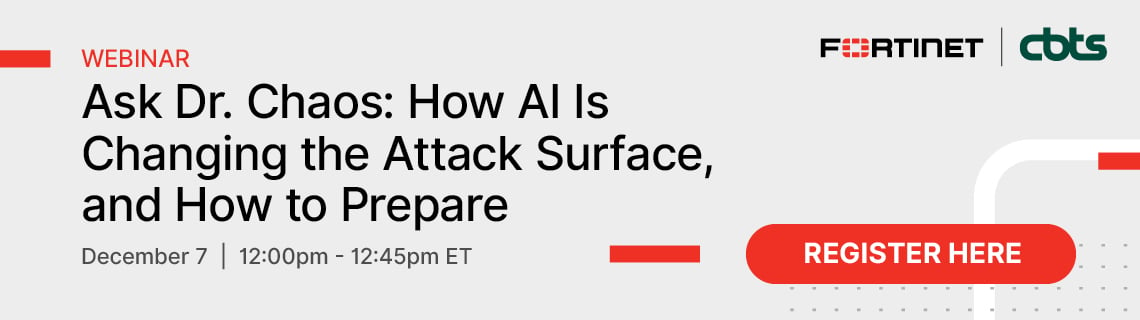
AI is helping attackers work faster and at greater scale, which widens the gap for organizations with lean security teams. The more locations, devices, and cloud apps you add, the more opportunities that speed gives an attacker. That’s the focus of our upcoming webinar with Fortinet.
Our firewalls and switches are near end of life. Can we upgrade without a big capital expense?
Yes, you can upgrade equipment without a big capital expense. With a subscription-based managed service, hardware is part of a predictable monthly fee instead of an upfront capital purchase.
As part of CBTS Fortinet Managed Services, CBTS retires your aging switches, firewalls, and access points and keeps the hardware refreshed on an ongoing basis. That means no more surprise forklift upgrades blowing up the budget. The money you would have sunk into equipment can go toward your people, locations, or next expansion.
How can we bring new sites or acquired companies online quickly without creating security gaps?
The fastest, safest approach to onboarding is to manage security settings centrally; that way, each new site gets a proven configuration instead of one built from scratch. Going forward, growth doesn’t have to wait on IT to scope, order, and configure everything site by site.
Because CBTS builds and pushes security settings from one console, new sites, expansions, and even acquisitions can come online quickly and securely.
How can a small IT team pass security audits and meet cyber insurance requirements?
Auditors and insurers want to see consistent security settings and continuous monitoring, which are exactly what’s hardest for a lean team to maintain. A managed service can supply both, along with the documentation to prove it.
CBTS holds more than 100 security and compliance certifications and credentials, including HIPAA, PCI, and CMMC, and helps lean teams meet those requirements with far less effort. That can mean smoother audits, fewer penalties, and greater ease in acquiring and retaining cyber insurance.
Do we lose visibility or control if we outsource network management?
You shouldn’t lose visibility or control if you outsource network management. Handing off day-to-day operations is not the same as handing off decisions. A good provider gives you clear reporting and keeps you in the loop on changes. And with one accountable partner, you always know who to call. Nobody points fingers at another vendor when something breaks.
How does the cost of managed network security compare to running it in-house?
For a fair comparison of managed network security versus in-house management, look at the full cost of doing it yourself, not just the price of the hardware. That includes equipment purchases and refresh cycles, licensing, salaries and benefits for enough engineers to cover 24x7, ongoing training and certifications, and the cost of recruiting when someone leaves.
A managed subscription rolls those costs into one predictable monthly payment, with no upfront capital investment.
Is Fortinet a good fit for a mid-sized company?
For many mid-sized companies, Fortinet is a good fit. Fortinet is an industry leader in networking and security, reporting leading market share for firewall shipments worldwide. Just as important for mid-sized budgets, Fortinet delivers that capability at a price that undercuts premium competitors.
Because Fortinet runs networking and security on a single operating system, it’s well suited to organizations that want one platform rather than a patchwork of vendors.
What’s the difference between a Fortinet reseller and a Fortinet managed service provider?
A reseller sells you the platform; a managed service provider delivers the outcome. With a reseller, your team is typically left to deploy, configure, monitor, and update the equipment after the sale. A managed service provider takes on that ongoing work.
CBTS is an established managed services provider with more than 1,100 clients across more than 29,000 sites worldwide. CBTS is a Fortinet Expert tier partner with a growing team of Fortinet-certified engineers.
What should we look for in a managed network security provider?
When evaluating managed network security providers, look for round-the-clock operations run by the provider’s own engineers, a single point of accountability, deep vendor certifications, and compliance experience in your industry. Specifically, ask whether the provider offers:
- A 24x7 Network Operations Center and Security Operations Center staffed by its own engineers
- Direct access to experienced engineers
- One team from assessment and design through daily operations
- A high partner tier and certified engineers for the platform you’re using
- Compliance credentials that match your requirements
- Ongoing hardware refresh included, not billed as a separate project
CBTS Fortinet Managed Services checks each of these boxes, with one team and one bill.
When does it make sense for a mid-sized company to outsource network security?
Outsourcing usually makes the most sense when your network is growing faster than your IT team. That's especially true for organizations operating multiple locations and those with a small IT team (or none at all) and no interest in hiring more engineers to run the network.
The timing is often right when you’re facing a cloud move, an upcoming audit, a cyber-insurance renewal, a recent security scare, or staff turnover. CBTS works with many retail and food service companies, financial institutions (including regional credit unions), manufacturers, and healthcare clinics.
How do I learn more?
Register now to join CBTS and Fortinet for Ask Dr. Chaos: How AI Is Changing the Attack Surface, and How to Prepare at noon ET on December 7, 2026. To start the conversation sooner, get in touch with your CBTS account team or contact us today.