







Demand for AI hardware is hotter than asphalt in the summertime. Organizations are understandably concerned about getting burned by supply chain issues, including long lead times and unpredictable pricing.
It often looks like this: Your hardware budget was approved in Q4 with deployment scheduled for Q2. Since then, your quote has expired twice, and the configuration now costs 30% more than it did when leadership signed off on it. So, while your project hasn’t moved, the numbers have.
At first glance, this might seem like a procurement problem. In reality, it’s a timing problem — and you need a strategy for solving it.
Pressure points in the supply chain
Traditional procurement assumes the world is stable between approval and deployment. That assumption was always slightly wrong. But now demand is soaring for the servers and storage products essential to AI factories. The impact on procurement can feel dizzying.
CBTS studied the challenge among our clients. Our pricing analysis found that from December 2025 to April 2026, 64GB RDIMM memory was up 142%, server controllers surged 92%, EPYC CPUs rose 53%, and a 10-node cluster increased 115% like-for-like.
Every quote in our dataset expired within 10 to 14 days. When clients are stuck in approval cycles, they’re simultaneously repricing, and it’s always upward.
In a market like this, when to buy and when to take delivery are no longer a single decision.
Servers and storage for AI workloads: Why it’s time to buy-and-hold
Buy-and-hold has been the most disciplined investment strategy over the past 100 years. It’s simple: Acquire the asset at today’s price. Hold the position. Capture the value over time.
The same logic now applies to the procurement of servers and storage products essential to AI workloads. The math can be among the most compelling investment positions a business leader will see this year.
Here’s how the buy-and-hold strategy works with servers and storage products for memory-intensive configurations:
-
- You buy at today’s locked price.
- A trusted partner holds the hardware in their warehouse.
- You take delivery when your project is ready.
The carrying cost is predictable. The price exposure is gone. And you save your place in line, protecting against extended lead times.
Investors expect carrying costs and build them into expected returns. So, the question isn’t whether the carrying cost is worth paying — it’s whether the price exposure is worth risking.
In today’s market, the math isn’t even close.
The business case for buying and holding
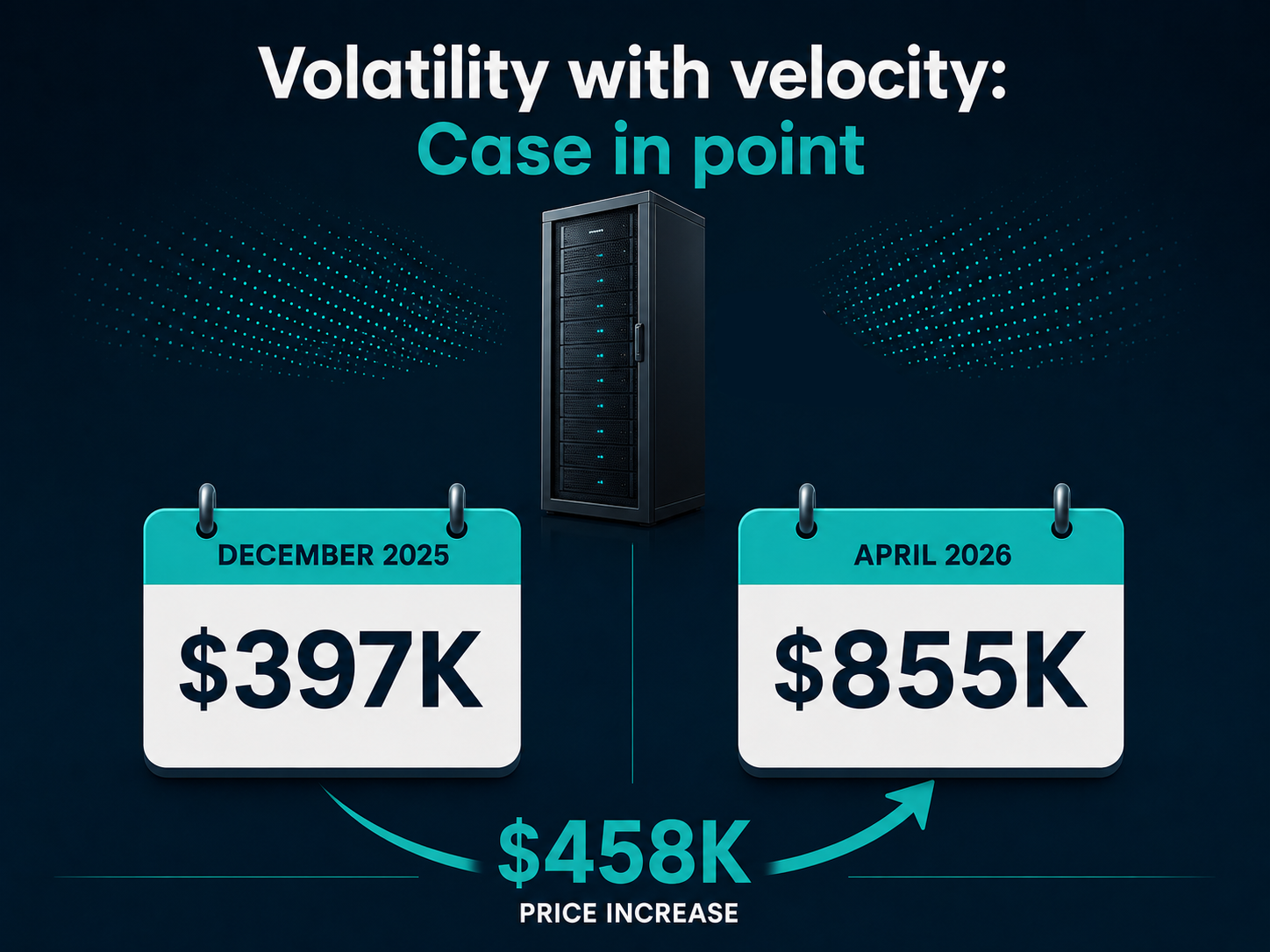
Consider a typical 10-node enterprise server cluster. Priced in December, the configuration came in at roughly $397,000. Repriced in April for the same specs: $855,000. That’s a $458,000 swing on a single project, driven entirely by approval-cycle drag against a market the client didn’t control.
Now consider the alternative: the same cluster purchased in December at the locked price, stored and secured by CBTS for six months while the project moves toward deployment readiness, with a predictable monthly carrying cost.
The carrying cost is a fraction of the price-increase exposure it neutralizes. That transforms it from a smart procurement decision into a risk management play.
Bottom line? Every week of approval-cycle drag in a volatile market is a week of price exposure. A buy-and-hold approach eliminates that exposure to the hardware you’re going to buy anyway. It’s an innovative way to keep you cool even in a hot market.
Where does this fit in with a broader infrastructure strategy?
This approach isn’t right for every workload and every project. For new workloads with unpredictable scaling, cloud-native architecture eliminates the need for procurement entirely. But for workloads that require memory-intensive configurations on-premises, a buy-and-hold option neutralizes the timing risk on the server and storage purchases you know you’re going to make.
CBTS is actively developing a buy-and-hold managed inventory program built around the procurement discipline our infrastructure team has refined over years of high-volume enterprise hardware deployment.
We’ll have more to share in the coming weeks. In the meantime, if your team has approved a budget and a deployment timeline that spans the next two quarters, this is the conversation to have now — before another quote cycle drives up the price.
Reach out for an early look — we’re previewing the program with select clients now. Fill the form below to book a 1:1 consultation with us!